
The Rules of Golf allow 14 clubs in your bag, and a full set of 14 is easy to fill badly. Two clubs hit the same distance, a 40-yard hole sits between your longest iron and your shortest fairway wood, and a fifth wedge duplicates a club you already carry. Players who build a 14-club Golf Bag well tend to treat the limit as a budget of slots, with each slot assigned to a distance or a shot. A well-constructed 14-club Golf Bag can enhance your overall game performance.
This guide will help you refine your 14-club Golf Bag choices to enhance your game.
This guide covers how to build a 14-club Golf Bag in that order: measure your distances, find the gaps and overlaps, then decide what goes in each slot. The right answer depends on your swing speed, how you miss, and the courses you play, so the aim is to give you a method rather than a shopping list. Understanding your ideal 14-club Golf Bag setup can transform your game.

Understanding how to optimize your 14-club Golf Bag can lead to better performance on the course.
Why the 14-club limit is a design problem, not a checklist
Choosing the right clubs for your 14-club Golf Bag is essential for maximizing your game.
A checklist says every bag needs a driver, a 3 wood, a 5 wood, a 4 hybrid, 5 through 9 iron, three wedges and a putter. That adds up to 14 for some players and leaves out what others actually need. A golfer with a 90 mph driver swing and a golfer with a 110 mph swing do not need the same long clubs. A player who misses short-sided around the green needs something different from a player who loses shots off the tee when building their 14-club Golf Bag. Every choice impacts your performance.
Your 14-club Golf Bag should reflect your strengths and weaknesses as a player.
In stroke play, carrying a 15th club costs two penalty strokes for each hole where you had it, up to a maximum of four strokes for the round. Each time you consider adding to your 14-club Golf Bag, remember the penalties involved. The limit is worth respecting, but it also helps you: a hard cap forces you to ask what each club does that no other club in the bag does in your 14-club Golf Bag.
Click on the text link here and go browse Pinemeadow’s remarkable selection of clubs for the best deal! ⇒ https://www.kqzyfj.com/click-8400904-1142622/
Never underestimate the importance of each club in your 14-club Golf Bag.
A useful way to frame it is to split the bag into four jobs:
Make sure your 14-club Golf Bag is balanced and efficient for your style of play.
- Distance off the tee: driver and possibly one fairway wood.
- Long approach shots: fairway woods, hybrids or long irons.
- Scoring approaches: mid and short irons.
- Short game and putting: wedges and putter.
Each job needs enough clubs to cover its range of distances without gaps. When one job takes too many slots, another goes short. A bag with four wedges and no club between your 5 iron and your 3 wood is a common example.

Finding the right combination for your 14-club Golf Bag can be game-changing.
Start with your distances: how to find the gaps in your current bag
Knowing the gaps in your 14-club Golf Bag can help you make informed decisions.
Before you buy anything, find out how far each club goes. Use carry distance, which is how far the ball flies before it lands, rather than total distance with roll. Roll varies with turf, weather and slope, while carry is what you need to clear a bunker or reach a green.
Your 14-club Golf Bag should evolve as your skills improve.
You can collect these numbers in a few ways:
Gathering data on your clubs will improve your 14-club Golf Bag setup.
- A launch monitor session at a fitting studio, a golf store or a driving range with ball-tracking bays.
Understanding distances is critical for your 14-club Golf Bag configuration.
- A rangefinder on the range, hitting to targets at known distances.
- A golf GPS or shot-tracking app over several rounds, which shows what you actually hit on the course.
Hit at least ten shots with each club. Throw out the obvious mishits, then take the average of the solid strikes. A single best shot is not your distance, since you will not repeat it on every hole.
A well-calibrated 14-club Golf Bag can significantly improve your scores.
Write the numbers in a column from driver down to your sand wedge. Then look at the difference between neighboring clubs. Many players find gaps of roughly 10 to 15 yards between irons. Treat that as a rough pattern rather than a rule, because swing speed and club design change it.
Fine-tuning your 14-club Golf Bag will help you navigate the course’s challenges.
Two things to look for:
Your 14-club Golf Bag must be tailored to the types of courses you play.
- A gap of 20 yards or more between two clubs. You have a distance you cannot cover with a full swing. You will be hitting three-quarter shots or choking down, and those are harder to control.
- Two clubs within about 5 yards of each other. One of them is redundant, and that slot could cover a gap elsewhere.
Assessing the roles of each club in your 14-club Golf Bag is crucial for lower scores.
Next, add your weak spots to the list. Which distances leave you between clubs most often on the courses you play? Where do your worst scores come from: long par 3s, par 5 second shots, shots inside 100 yards? The slots you assign should answer those problems first.
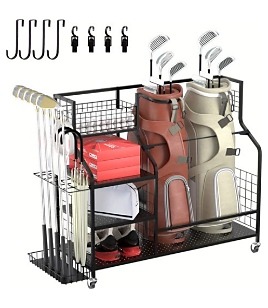
Consider how each club fits into your 14-club Golf Bag strategy.
Driver and fairway woods: how many long clubs you can actually hit
Long clubs in your 14-club Golf Bag require careful selection based on your swing.
The driver is a single decision with a lot of variables: loft, shaft flex and weight, and head design. Players with slower swing speeds often get more carry from a higher loft than they expect, while faster swingers can use lower lofts without losing launch. That is a general pattern, and a fitting session with launch data will tell you more than any chart. If you are comparing models, the top-rated golf drivers page lists options.
Evaluate how each long club fits into your 14-club Golf Bag.
Fairway woods raise a more interesting question: how many can you hit well, and from what lies? A 3 wood is useful for two jobs, a second tee club on tight holes and a long approach on par 5s. Many players find it hard to hit from the fairway, especially off tight lies, and some use it only from the tee. If that describes you, a higher-lofted fairway wood such as a 4 or 5 wood may get off the ground more reliably and still gives you real distance.
Some questions to settle your long-club count:
- Do you hit your driver straight enough to use it on most par 4s and 5s? If not, a 3 wood off the tee may be a better second option than a longer-shafted club you cannot control.
- Is the carry gap between your driver and your longest iron larger than 40 yards? If so, you probably need two clubs in that range, not one.
- Do your fairway woods carry within 10 yards of each other? If so, you can drop one of them.
A 3 wood and a 5 wood are a common pair. Another route is a 3 wood and a 7 wood, which suits players who want high, soft-landing approaches and find mid-lofted woods easier than long irons. Whichever you choose, test them off the turf and not only off a tee. The club you can hit from the ground is the club that earns its slot.
Hybrids or long irons: filling the middle of the bag
Filling your 14-club Golf Bag with the right middle clubs can solve distance gapping issues.
The middle of the bag is where most gapping problems appear. Players carry a 4 iron they rarely hit well, or they skip from a 5 wood to a 6 iron and leave 25 yards uncovered. Hybrids were made to fix this, since their wider soles and lower center of gravity help the ball launch higher from a range of lies.
Long irons still have a place. Faster swingers who control trajectory well may prefer the shot shaping and lower flight of a 3 or 4 iron, particularly in wind. If you can hit a long iron to a predictable distance and it does not leave you short of the green, it can stay in the bag.
A practical way to decide is to compare the same distance with two clubs. Hit ten balls with your longest iron and ten with a hybrid of similar loft, on grass if you can. Compare:
Testing different clubs in your 14-club Golf Bag will yield better results on the course.
- Average carry. Whichever club carries more consistently usually covers the distance better.
- Dispersion. If one club spreads shots 30 yards wider than the other, the tighter one is worth the slot.
- Height and stopping power. A shot that lands steeply holds a green. One that comes in low and runs may be fine on links-style courses but is a problem on firm, elevated greens.
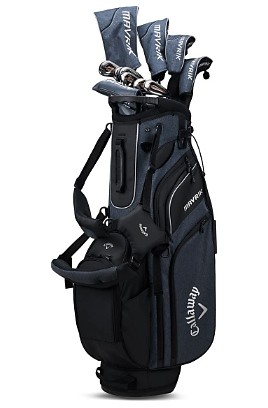
Callaway Golf Clubs and Bag
Your 14-club Golf Bag should evolve with your game style.
Many players end up with two hybrids replacing the 3 and 4 irons. Some keep a hybrid in place of the 5 iron too, and start the iron set at 6. There is no wrong number as long as the distances do not overlap. The best-rated fairway woods and hybrids page is covered again at the end of this guide, because that slot is where many bags need the most work.
Iron sets: choosing a forgiving set and where to split into combo sets
The iron set is the largest purchase for most players and the one that stays in the bag the longest, so it deserves the most careful decision. The main trade-off is forgiveness against feel and control. Cavity-back and larger-headed irons resist twisting on off-center hits and tend to lose less distance there. Smaller, forged or blade-style irons give more feedback and more room to shape shots, but they penalize mishits more.
Be honest about your strike pattern. If your contact is scattered across the face, a more forgiving set will save more shots than a better-feeling set will gain. If you hit the center of the face most of the time, you can accept less forgiveness in return for control.
Two practical points often get missed:
Understanding the best wedges for your 14-club Golf Bag can greatly influence your short game.
- Check lofts, not numbers. Iron lofts in many modern sets are stronger than in older sets, so a modern 7 iron can carry as far as an older 6. That means a modern pitching wedge may be 43 to 46 degrees, and your wedge gaps need to start from the real loft stamped on your set.
- Consider a combo set. Many players are more forgiving with their long irons than their short ones. A combo set pairs game-improvement long irons (say 4 through 6) with more compact, controllable short irons (7 through PW). That matches the clubs to how the swing behaves. A fitter can also bend lofts and lies to blend a set.
The best-rated golf irons page compares sets across the categories. If you want a closer look at specific sets, this site also has individual write-ups of the Mizuno JPX923 Forged irons and the TaylorMade SIM2 Max irons.
Consider how many irons you need in the set as well. Buying a 4 through PW set gives you seven irons, but if you replace your 4 and 5 with hybrids, you may only need 6 through PW, which saves money and a slot or two for other clubs.
Wedges: gapping loft and bounce for the shots you really face
Wedges are where players most often waste a slot or leave a gap. Start with the loft of your pitching wedge, then add wedges at intervals of roughly 4 to 6 degrees. For example, if your pitching wedge is 45 degrees, a gap wedge around 50 and a sand wedge around 54 or 56 cover most full-swing distances inside 120 yards. That is an illustration of the method, so use your own set’s lofts.
After loft, think about bounce, which is the angle of the sole that keeps the leading edge from digging in. A rough guide:
Effective wedges in your 14-club Golf Bag will enhance your scoring opportunities.
- Steeper swings and soft turf or fluffy sand generally work better with more bounce.
Incorporating different bounce types in your 14-club Golf Bag can adapt to various lies.
- Shallow swings and firm turf or compact sand generally work better with less bounce.
- Mid bounce is a reasonable all-around choice if you play varied courses.
Choosing the right club for your 14-club Golf Bag can lead to improved performance around the greens.
Look at the shots you face most often. If your local course has soft, deep bunkers, your sand wedge needs enough bounce to help. If your course has tight, firm lies around greens, a lower-bounce lob wedge opens up options.
Now the trade-off: do you need a fifth wedge? Most players do not. Three wedges after the pitching wedge (a gap, a sand and a lob wedge) leaves the pitching wedge as the fourth wedge in the bag. A fifth would only help if there is a distance you hit often and cannot cover with a partial swing. Otherwise, spend that slot on a hybrid or fairway wood, which usually adds more on long approaches than a second lob wedge adds around the green.
Evaluate the need for a fifth wedge in your 14-club Golf Bag based on your shot patterns.
Wedges also wear. Grooves lose spin as they flatten, and players who practice often may replace wedges more frequently than any other club. The top-rated golf wedges page is covered in the closing section, with the other slots.
Worn clubs in your 14-club Golf Bag can impact your game; replace them regularly.
Putter: the club you use most deserves a real fitting decision
The putter is a key element in your 14-club Golf Bag; choose wisely.
Most golfers use the putter on every hole, and often more than any other club in a round. Yet many choose by looks. Three fit points matter more than appearance:
Ensuring the right fit for your putter in your 14-club Golf Bag can enhance your performance.
- Length. The putter should let your eyes sit over or just inside the ball line with a comfortable posture. A putter that is too long or too short pushes you out of that position.
Try different putters to find the best match for your 14-club Golf Bag.
- Lie angle. If the toe or heel sits up at address, the face can point away from your target at impact.
- Head design and balance. Players with a straight-back, straight-through stroke tend to do well with face-balanced putters, while players with an arced stroke often prefer some toe hang. Blades and mallets also differ in forgiveness on off-center hits.
Try several shapes on a practice green, and roll ten-foot putts with each one. Note which head you can aim comfortably, since confidence in alignment affects results. Grip size and weight also matter. The top-rated golf putters page lists options to narrow down before you try them in person.
One caution: putter changes can feel good for a few rounds, then fade. A club is worth keeping if the improvement shows in makes from three to eight feet over many rounds, not just one good day.

The last slot: what to do with your 14th club
Your 14-club Golf Bag’s final slot must be thoughtfully considered.
Once the driver, long clubs, irons, wedges and putter are set, you may have one slot left, or none. If you have one, assign it to the biggest scoring leak your records show. Some options:
Fill the last slot in your 14-club Golf Bag based on your most pressing needs.
- An extra wedge, if you have a distance inside 100 yards that you cannot cover with a full or controlled partial swing.
Consider a versatile club for your 14-club Golf Bag to cover unexpected shots.
- A 7 wood or additional hybrid, if you struggle on long par 3s or find long irons difficult to launch.
- A driving iron or utility iron, if you want a low-flying tee shot for tight or windy holes.
Assess your 14-club Golf Bag’s gaps and fill them strategically.
- A second fairway wood, if you have a gap between the driver and the first iron.
Decide carefully on the last club for your 14-club Golf Bag.
Leaving the slot empty is also legal. Playing 13 clubs costs nothing, and it may be wise while you collect distance data and find where the real gap is. Fill it when the numbers show a need, not because the bag has space.
Ultimately, your 14-club Golf Bag should reflect your playing style and needs.
A simple order for upgrading your bag without spending it all at once
Rebuilding every club at once is expensive and often unnecessary. A staged order lets you spend where the improvement is largest first:
- Use what you have. Remove duplicates and rearrange the set before buying. If two clubs cover the same distance, replacing one is usually cheaper than buying an extra.
- Fix the widest gap. Compare your distances and fill the largest hole, which for many players is between the irons and fairway woods or between pitching wedge and sand wedge.
- Wedges and putter. These are used on a high share of shots and wear out faster, so they repay a careful fit.
- Hybrids and fairway woods. Test them off the turf and replace the long irons you cannot hit consistently.
- Irons. Replace the set when strike quality and distance gaps show that the current one no longer fits, and consider a combo set if your long and short irons need different help.
- Driver. A new driver can add distance, but if your current one fits your swing speed and launch, other slots usually offer more.
If budget matters, check the site’s golf club deals page for current offers before you buy.
Pick the one slot where your bag has the biggest gap, then browse the top-rated pages for that club type, such as top-rated golf wedges or best-rated fairway woods and hybrids, to compare options through the links on the site. Commissions from the advertiser support this site when you buy through those links.
Click on the text link here and go browse Pinemeadow’s remarkable selection of clubs for the best deal! ⇒ https://www.kqzyfj.com/click-8400904-1142622/


